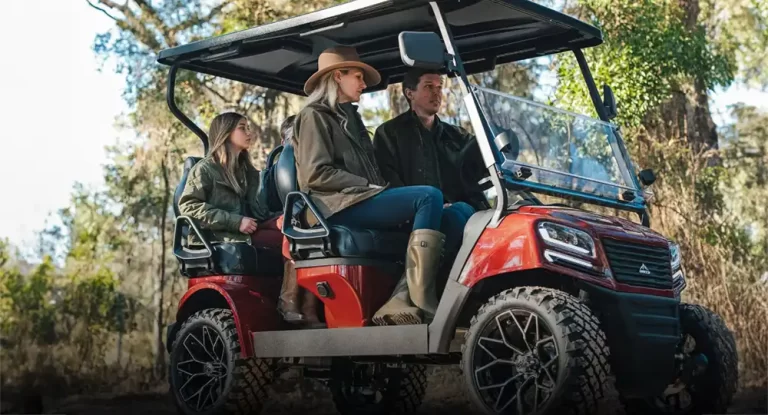
The idea of driving a golf cart to the coffee shop, the park, or a neighbor’s house a few miles away sounds appealing to a lot of people. For a growing number of Americans, that idea has become a daily reality. Street legal golf carts are no longer a novelty reserved for retirement villages and resort towns. They are practical, affordable, and increasingly common on the roads of communities across the country. But getting to that point legally requires more homework than most buyers initially expect.
What Makes a Golf Cart Street Legal
The phrase “street legal golf cart” gets used loosely, but it has a specific meaning from a regulatory standpoint. In the United States, vehicles that travel between 20 and 25 miles per hour fall under a federal classification called low-speed vehicles, or LSVs. This category was established by the National Highway Traffic Safety Administration and comes with a defined list of required safety equipment that every street-legal cart must have.
To qualify as a road-legal LSV, a cart must be equipped with headlights, taillights, brake lights, turn signals, reflectors, a rearview mirror, a windshield, a windshield wiper, seat belts for every passenger, and a vehicle identification number. The cart must also be capable of reaching at least 20 miles per hour and must not exceed 25 miles per hour.
A standard golf cart fresh off a course fleet does not meet these requirements. Getting one road-ready means either purchasing a cart already built and certified as an LSV or buying a standard cart and outfitting it with the necessary equipment before registration.
Where Street Legal Carts Are Allowed to Operate
Meeting the federal LSV standard is only half of the equation. Whether and where you can actually drive your cart on public roads is determined by state and local law, and those rules vary considerably.
Most states allow LSVs to operate on roads with posted speed limits of 35 miles per hour or less. Some states extend that to 45 miles per hour under certain conditions, while others are more restrictive. Crossing intersections with higher speed limits is generally permitted in most states even when through travel on those roads is not.
Colorado has been relatively welcoming to low-speed vehicles on public roads. The state allows LSVs on roads with speed limits up to 35 miles per hour and permits them to cross roads with higher speed limits at designated intersections. Individual municipalities can layer additional rules on top of state law, so checking with your city or county transportation office before you start shopping is always a smart first step.
Titling, Registration, and Insurance in Colorado
Once you have confirmed that road use is permitted in your area, the process of making your cart street legal involves several administrative steps that are similar to registering any other motor vehicle.
In Colorado, LSVs must be titled and registered with the state. You will need to provide proof of ownership, pay applicable fees, and have the vehicle inspected in some cases. A valid driver’s license is required to operate an LSV on public roads, and liability insurance is mandatory. Some insurers offer dedicated LSV or golf cart policies that provide coverage tailored to these vehicles at reasonable premiums.
It is worth noting that standard golf carts, even well-equipped ones, cannot always be converted to full LSV compliance without significant modifications. If road use is your primary goal, buying a cart already certified as an LSV from a reputable dealer is typically the cleaner and more cost-effective path.
Finding the Right Cart for Road Use in Colorado
The good news for Colorado buyers is that the market for street-legal carts has grown considerably in recent years. Dealers across the Front Range and beyond have responded to rising demand by expanding their LSV inventory and bringing in models specifically designed and certified for road use.
For buyers actively searching for Colorado street legal golf carts for sale, the options available today span a wide range of price points, configurations, and feature sets. Entry-level LSVs from brands like ICON and Advanced EV offer solid road-ready performance at accessible prices. Premium options from Club Car, Yamaha, and E-Z-GO deliver a more refined experience for buyers willing to invest more upfront. Specialty builds with lifted suspensions, upgraded interiors, and custom features are also widely available for buyers who want their cart to stand out as much as it performs.
Shopping locally is a significant advantage in this category. A knowledgeable local dealer can confirm which models already carry federal LSV certification, walk you through the Colorado registration process, and ensure the cart you buy will pass any required inspections without additional out-of-pocket modifications.
Electric vs. Gas for Road Use
For most buyers using a street-legal cart primarily for short neighborhood trips and local errands, electric is the practical choice. Modern electric LSVs are quiet, clean, inexpensive to operate, and increasingly capable thanks to improvements in lithium battery technology. A full charge costs very little and covers enough ground for the vast majority of daily use cases.
Gas-powered LSVs do exist and carry some advantages for buyers who travel longer distances or live in hilly terrain where battery range becomes a more pressing concern. The trade-off is higher operating costs, more maintenance, and the added noise that comes with a combustion engine in what is fundamentally a neighborhood vehicle.
For most Colorado Front Range communities where road use is relatively flat and distances are short, electric wins the comparison comfortably.
Safety Habits That Matter on Public Roads
Driving a golf cart on public roads requires the same respect for traffic laws that applies to any other vehicle. Signaling turns, coming to complete stops, yielding to faster traffic, and staying out of lanes designated for higher-speed vehicles are all basic habits that keep cart drivers and everyone around them safe.
Wearing seat belts is not only a legal requirement in an LSV but a genuinely important safety practice. Golf carts have a higher center of gravity than most passenger cars, and even a low-speed collision or sharp turn can cause real harm to unbelted occupants.
The Bottom Line
Street legal golf carts offer a compelling mix of practicality, affordability, and fun for buyers whose daily transportation needs include a lot of short trips in lower-speed environments. Getting there legally takes some research and the right purchase decision, but the payoff is a vehicle that genuinely earns its place in your garage and your routine.